

What SAP Announced About BAIP
At SAP Sapphire in May 2026, SAP introduced the SAP Business AI Platform (BAIP). The most common misreading of that announcement is that SAP renamed SAP Business Technology Platform. It did not. BAIP is a consolidation: SAP describes it as now unifying SAP Business Technology Platform, SAP Business Data Cloud, and SAP Business AI into a single, governed environment. BTP is inside BAIP, not replaced by it.
That distinction matters because it changes the question. This is not a migration to plan. It is a widening of what the platform you already own is expected to do.
Why it Matters for Enterprise AI
Most enterprise AI programs stall for the same three reasons: the models lack trusted business context, there is no governance anyone will sign off on, and nothing connects cleanly to operational systems. BAIP is SAP’s attempt to solve all three in one place rather than leaving customers to assemble the answer themselves.
SAP CEO Christian Klein put the rationale plainly at Sapphire: “For the mission-critical processes of our customers, ‘almost right’ just isn’t good enough.” Accuracy and governance are being positioned as the product, not as friction around it.
How BAIP Fits Within SAP’s Autonomous Enterprise Architecture
SAP describes the Autonomous Enterprise as Joule Work, the SAP Autonomous Suite, and SAP Business AI Platform, plus industry-specific scenarios delivered as Industry AI. Joule Work is the engagement layer, where people describe what they want in natural language instead of navigating screens. The Autonomous Suite executes the work; SAP says it will deploy more than 50 domain-specific Joule Assistants across finance, supply chain, procurement, HR, and customer experience, orchestrating a subset of more than 200 specialized agents. BAIP is the foundation underneath all of it.
Worth holding onto: BAIP is the foundation layer, not the whole vision. Evaluating it in isolation misses both the interface users will actually touch and the applications where outcomes are produced.
The Three Business AI Platform Pillars
SAP consistently frames BAIP around three pillars — Build, Contextualize and Reason, and Govern. The framing is useful because it concedes that enterprise AI is not a model problem. It is a tooling, context, and control problem, and all three have to work at once.
1. Build
This centers on Joule Studio, SAP’s AI-first environment for creating agents, applications, and agentic workflows on SAP-managed infrastructure. Notably, it is open rather than closed: developers can work in Visual Studio Code, use common agent frameworks, orchestrate visually through an embedded n8n environment, or build custom front ends with Vercel alongside SAPUI5 and SAP Fiori. SAP Integration Suite remains the layer connecting all of it to existing systems
2. Contextualize and Reason
This is the real differentiator. SAP places the SAP Knowledge Graph at the core of the platform, giving agents a structured map of business entities, processes, and relationships across a customer’s landscape. SAP Domain Models are trained on SAP-specific code, metadata, and process knowledge and are, in SAP’s words, “designed to provide results firmly grounded in SAP context instead of relying on generic internet knowledge.” Note the hedge. Grounding in trusted business data improves relevance, accuracy, and traceability; it does not eliminate error, and SAP does not claim it does.
3. Govern
This is where most AI programs actually fail. SAP AI Agent Hub, built on SAP LeanIX, acts as a vendor-agnostic system of record for agents, large language models, and Model Context Protocol servers, regardless of where they were built, with risk ratings, compliance mappings, and a verification workflow that blocks unverified assets from production. Beneath that, NVIDIA OpenShell provides sandboxed execution and policy enforcement. SAP frames the split neatly: OpenShell answers whether an action can safely execute, while the Joule Studio runtime answers whether it should happen at all.
One planning caveat. SAP LeanIX documentation describes AI Agent Hub as an optional feature of SAP LeanIX Application Portfolio Management, with agents counting against the application quota at a five-to-one ratio. SAP’s Sapphire materials say the hub is now available to more customers through Joule Studio. Confirm entitlement and cost with SAP rather than assuming it is included.
Model Selection and Sovereign AI Options in BAIP
BAIP is deliberately multi-model. SAP and Anthropic have announced plans for Claude to become a primary reasoning and agentic capability across the portfolio, powering Joule agents in HR, procurement, and supply chain, though SAP’s own press release describes Claude as “among the foundation models” the platform will leverage. Mistral is generally available on BAIP, and Cohere North was scheduled for June 2026, both positioned as sovereign options running on SAP infrastructure. Google Cloud and Microsoft partnerships add bidirectional agent-to-agent interoperability.
One clarification, because these roles get conflated: Anthropic, Mistral, and Cohere supply models. NVIDIA supplies the secure runtime beneath them. For regulated industries, the ability to choose both the model and the region is a more concrete argument than “enterprise-grade governance.”
Early Customer Results and Adoption Indicators
SAP has published a few data points. Sony’s Vanitha Ponnusamy reported that “Joule Studio generated an end-to-end solution in 10 to 15 minutes, replacing three to four days of manual development and coordination.” Accenture’s Suraj Gahalyan reported consistently high-quality code across 48 test scenarios. SAP also showcased work with RWE using Industry AI to help reduce unplanned downtime across offshore wind turbines, where agents are designed to analyze thousands of past incidents and generate pre-filled work orders.
Weight these appropriately. All were published by SAP, the Joule Studio examples reflect early access rather than production, and the RWE scenario is described in design terms. They indicate direction, not benchmarks. Expect to establish your own baselines.
What is Actually Available in BAIP
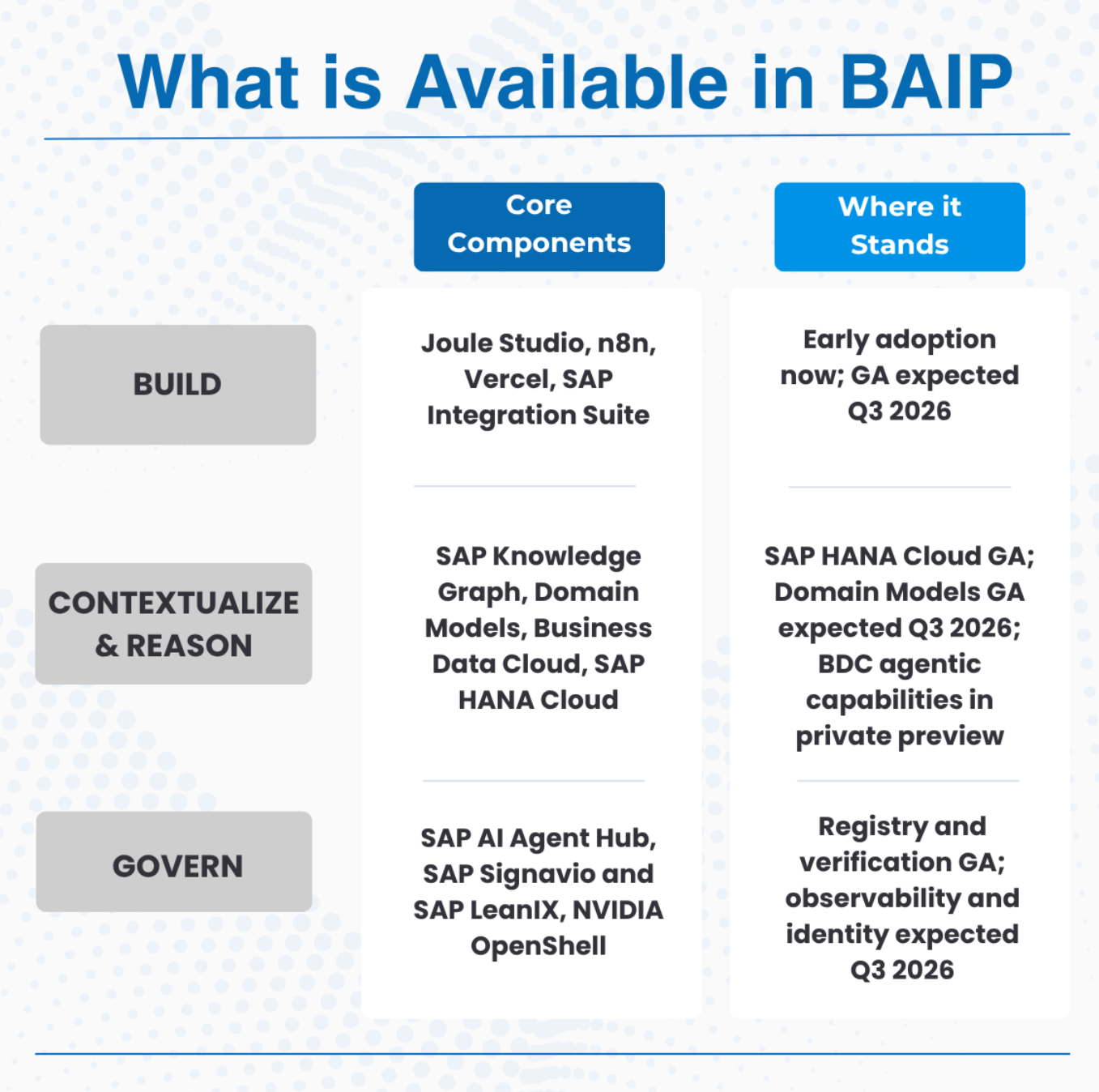
Note. Timing reflects SAP statements from May 2026. Several dates have since passed and SAP’s materials are inconsistent in places, so confirm current status before planning against any single date.
How to Evaluate SAP Business AI Platform Readiness
Readiness beats technology selection. Assess data quality, governance maturity, and executive sponsorship before deploying agents, then pilot against use cases with defined baselines. Governance frameworks should be in place before scope expands.
The near term is unusually favorable for evaluation. SAP is offering free Joule Studio design-time access to customers and partners through the end of 2026 under fair-use limits. A €100 million partner fund supports deployment of SAP-built assistants and agents. RISE with SAP customers get three Joule Assistants activated in their first year, and SAP GROW customers get full portfolio access at onboarding. Organizations still on SAP ECC or on-premise SAP S/4HANA that commit to moving the majority of their landscape to SAP Cloud ERP gain access to select AI scenarios in the interim.
If you work through implementation partners, note that SAP renamed the BTP partner competency to the SAP Business AI Platform competency effective June 30, 2026, with updated specializations in October 2026 and new proficiency requirements in January 2027.
The Path to Enterprise AI
BAIP is a portfolio and operating framework, not a product launch. BAIP is not a rename of SAP BTP, it’s a core component within it. Organizing capability around Build, Contextualize and Reason, and Govern gives SAP customers a defensible path to enterprise AI rather than another set of tools, and the emphasis on context and governance targets the failure modes that have stalled these programs elsewhere. Much of it reaches general availability between Q3 2026 and early 2027, which makes this a period for structured evaluation and targeted pilots rather than wholesale commitment.
Sources
SAP SE, “SAP Unveils the Autonomous Enterprise,” press release, May 12, 2026 · Michael Ameling, “Announcing New Joule Studio for Enterprise Scale Agentic Development,” SAP News Center, May 13, 2026 · Andre Lamego, “Shaping the Future of Secure AI Agents: How SAP and NVIDIA Are Co-Defining Enterprise-Grade Agent Execution,” SAP News Center, May 12, 2026 · SAP Sapphire 2026 Innovation News Guide · SAP Business AI Platform event site and product page · SAP LeanIX, “AI agent hub in SAP LeanIX” · SAP Community, “SAP BTP Competency Is Now SAP Business AI Platform Competency.”